Founding batch/First 500 tubs
She says
she's fine.
She says that whether it is true or not. Meanwhile most women over fifty take in less calcium, vitamin D and creatine than the guidelines and the research use.
One scoop in her coffee covers all three, at the doses the research actually uses.
Every ingredient links to its source. Check any of them.
A food supplement, not a medicine. These statements have not been evaluated by the Food and Drug Administration. This product is not intended to diagnose, treat, cure or prevent any disease.
$30 a tub/30 servings/Founding-list price
The founding batch opens to this list first, at $30 a tub. One email, nothing else.
Ships to her address / 30 servings a tub / Unflavoured
You are three time zones and four meetings away. One scoop a day is the small, easy thing you can still do for her, from your desk, tonight.
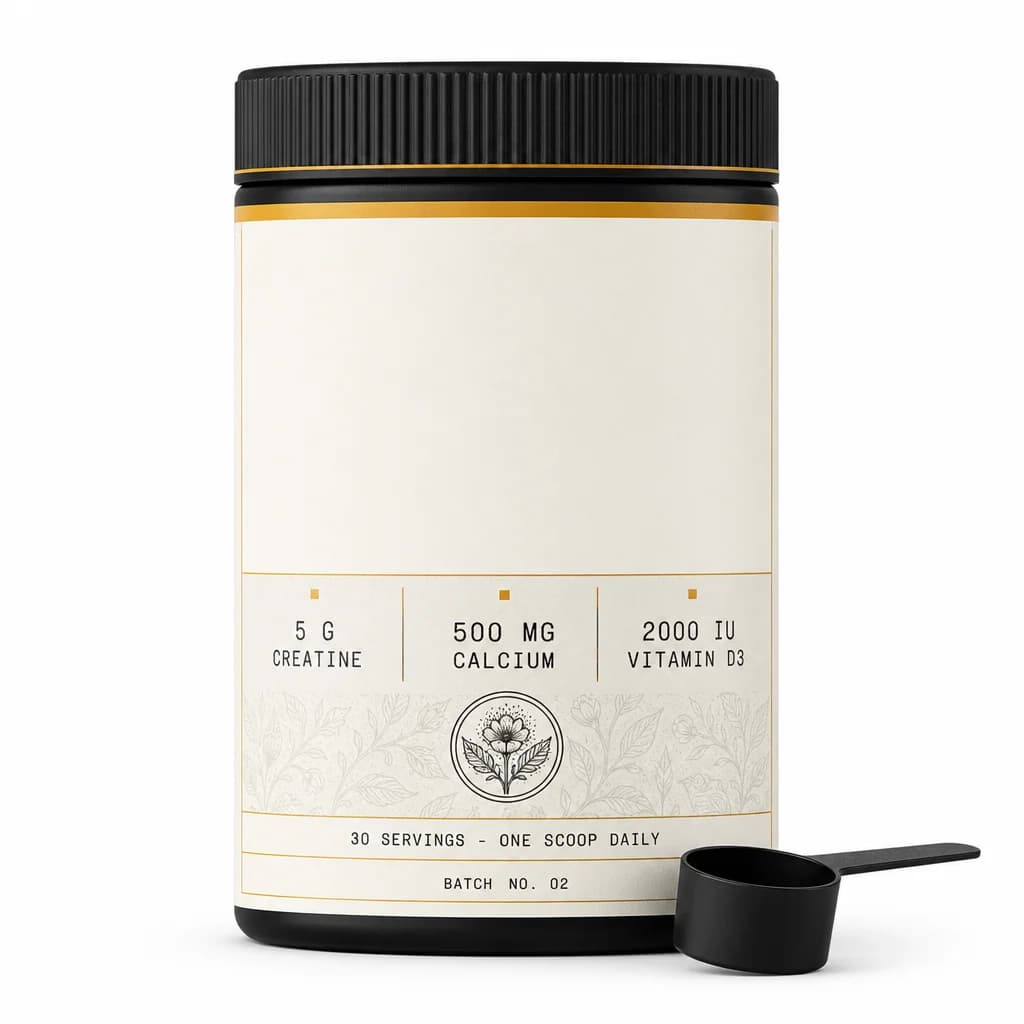
5 g
Creatine monohydrate
500 mg
Calcium
2,000 IU
Vitamin D3
Unflavoured. Stirs into coffee, tea or a smoothie. Three actives, no proprietary blends, every dose printed on the tub.
What each one is doing
Three actives / one system
The material
Calcium
Bone is not a finished object. It is taken apart and rebuilt continuously for her whole life, and calcium is the raw material that rebuilding runs on. The recommended daily intake goes up at fifty-one, which is roughly when most people are taking in less of it, not more.
The key
Vitamin D3
Calcium is barely absorbed without it, which is why the two belong in the same scoop. Skin makes D3 from sunlight, and it makes steadily less of it indoors and with age.
The muscle around it
Creatine
Not a gym supplement here. Muscle is what carries the groceries up the stairs, and the body holds onto less of it from about fifty onward. Creatine is the most-studied nutrient on the muscle side of that, and the trials that included women her age used five grams a day.
Why only 500 mg of calcium
Because 1,200 mg is the total from everything she eats in a day, not the amount that should come from a tub. Her food already supplies part of it. 500 mg closes the typical gap and stays well under the daily upper limit, which matters, because with calcium more is not better.
You call on Sunday. This shows up Tuesday.
She still carries the groceries up the stairs herself, the way she has for thirty years. You would like her to keep doing that for thirty more.
You already know what she says when you ask. She is fine, you should eat something, how is work. She is not going to bother you with anything smaller than an emergency.
So this is the quiet way to help. A tub on her counter, one scoop in her coffee, nothing for her to think about.
Why she is probably short
Intake figures / every number links out
Vitamin D, recommended
The recommended daily intake for adults, rising to 800 IU from 71. The NIH states that most people in the United States take in less vitamin D than recommended. Very few foods carry much of it, and skin makes less of it from sunlight indoors and with age.
Source: NIH Office of Dietary SupplementsCalcium, recommended
The recommended daily calcium intake for women from age 51. It goes up at fifty-one, right around the time dairy quietly leaves most people’s diets. The NIH lists women over 50 among the groups most likely not to be getting enough.
Source: NIH Office of Dietary SupplementsCreatine from food
What a normal mixed diet supplies in a day. Meat and fish carry roughly one to two grams. The research uses three to five grams a day, every day, consistently.
Source: ISSN position standThis is a food supplement, not a drug and not a diagnosis. It is a daily scoop of three nutrients most women over fifty take in less of than the guidelines recommend.
You can't carry the groceries.
You can send this.
$30 a tub for the founding list, 30 servings.
What you are sending her
Three actives / no blends
5 g
Creatine monohydrate
Research uses 3 to 5 g a day
The daily maintenance intake used across the strength and lean-mass trials, including studies in women over fifty.
Source: ISSN position stand500 mg
Calcium
Research uses 1,200 mg, all sources
A top-up, not a replacement. It closes a typical dietary gap without pushing anyone past the daily upper limit.
Source: NIH Office of Dietary Supplements2,000 IU
Vitamin D3
Research uses 600 to 800 IU a day
Calcium is barely absorbed without it, and indoor life makes far less of it than the recommendation assumes.
Source: NIH Office of Dietary SupplementsOne scoop daily / 30 servings per tub / unflavoured, stirs into coffee
Done in two minutes.
01
Two minutes, once
Leave your email. One link the day the founding batch opens. That is the whole ask.
02
It goes to her
Her address, not yours. Nothing in the box shows the price.
03
One tub is 30 days
Thirty servings, one scoop a day. When it runs low, you decide whether to send the next one.
Founding batch / First 500 tubs
Two minutes now.
She notices in a month.
We are making this for our own mothers first: same tub, same scoop, same three doses. The founding batch opens to this list before anyone else, at $30 a tub.
No spam, no drip sequence. One email the day the batch opens.